
Earned settlement: who pays for the ten-year wait?
Earned settlement means a ten-year wait to settle for many people earning under £50,271. Vishal Gautam on what that means for families, who it squeezes and what it costs.
Opinion · 3 November 2026 · 6 min read
5-year ILR advice
Settlement after 5 years: requirements, absences and costs.
Find out morePicture a software tester in Birmingham. She came on a Skilled Worker visa in 2025, earns £45,000 and pays her tax. Her husband and their fifteen-year-old daughter came with her. Under today’s rules, the family could settle in 2030. Earned settlement moves that to 2035. She is an illustration, but government figures put 146,000 Skilled Workers on the same ten-year path.
The Home Office’s own modelling says a Skilled Worker earning £41,700 puts around £347,000 more into the public finances over their lifetime than they take out. Under earned settlement, that worker waits ten years to settle, twice as long as today.
On 2 November the government confirmed how earned settlement will work. Ten years becomes the standard wait for indefinite leave to remain. People earning £50,271 or more can still settle after five years, and those earning £125,141 or more after three. The Immigration Rules have not changed yet and there is no start date, so nothing changes today.
I came to the UK on a student visa, when things were very different. The Skilled Worker visa did not exist yet; sponsored work meant a Tier 2 visa. I remember the extensions, the paperwork, the waiting and, yes, the tears. All of it was worth it on the day I became a British citizen. So when I read this response, I think of the people who are where I once was, and who have just been told the wait will be twice as long.
What ten years means for a family
For a family, five extra years can be half a childhood.
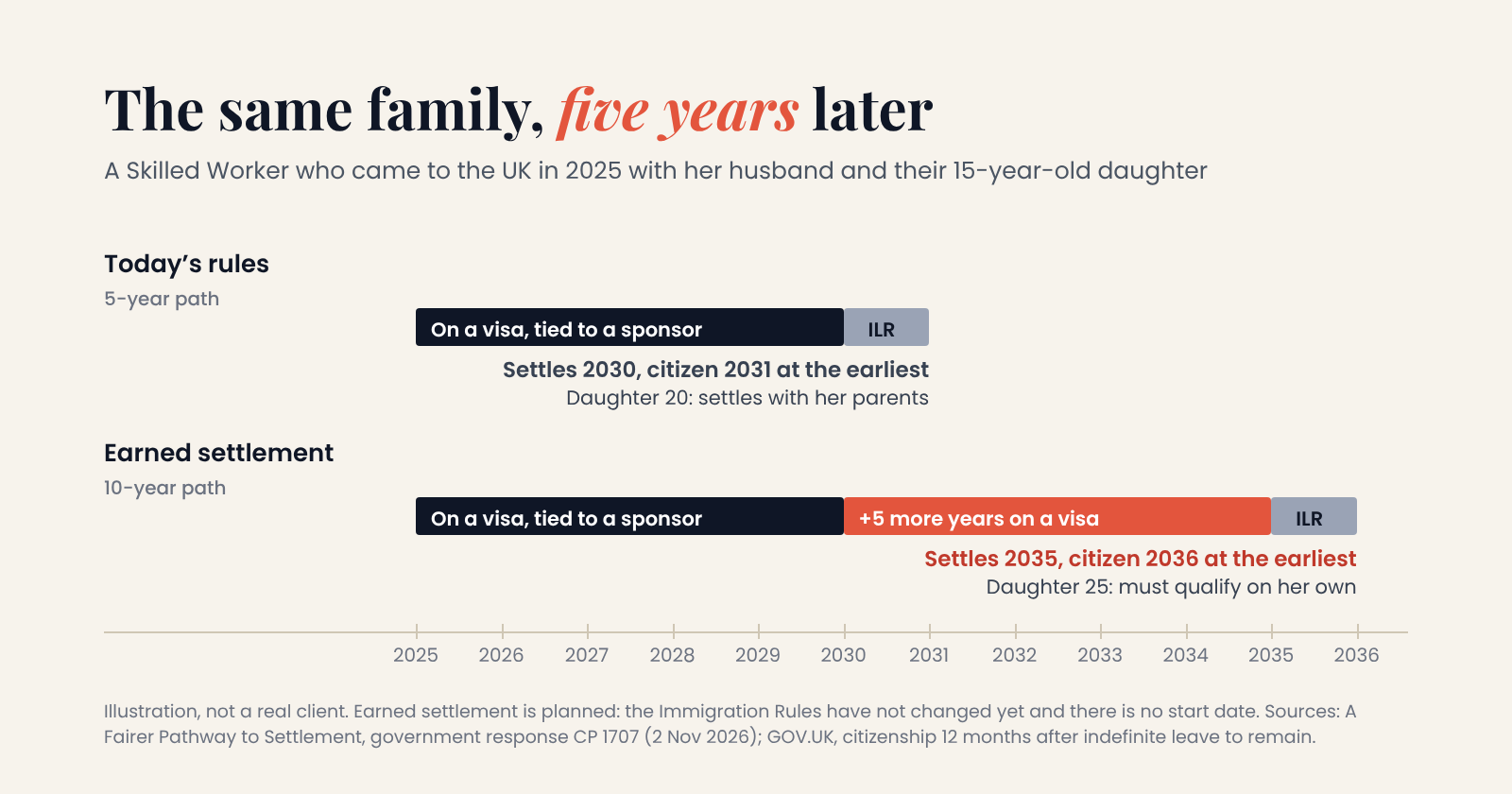
Her visa depends on her sponsor for five more years. Changing job means a new sponsor and a new application, and if her employer loses its licence or she loses her job, she may have as little as 60 days to find a new sponsor or leave the UK.
There is no safety net in that time. People on a Skilled Worker visa cannot claim most benefits, so if she falls ill or is made redundant there is no Universal Credit to fall back on. Claiming public funds in the five years before applying would also push the family onto the 20-year path.
Her daughter may have to start again on her own. Under today’s rules she would settle with her parents at twenty. On the ten-year path she turns twenty-five just as the family qualifies, and anyone aged 25 or over by then must qualify independently. The government’s response accepts that this “will principally affect young adults whose family has not yet reached settlement by the time they turn 25, for example because the family is on a longer settlement pathway”.
University gets harder too. In England, students without settled status usually pay international tuition fees and cannot get student loans, unless they meet other residence rules. A ten-year wait can cover a child’s last years at school and all of university.
Citizenship moves further away. Most people can apply twelve months after settling, so ten years to settle means around eleven years to citizenship.
A single mistake can add another ten years. Overstaying or breaching visa conditions as an adult can put someone on the 20-year path. The list of breaches has not been published yet, so families will live with that risk without knowing its exact shape.
All of this costs more as well. At today’s fees, the extra five years add around £7,040 in visa fees and the Immigration Health Surcharge for one worker, and around £19,825 for a family of three. Most of that is the health surcharge, paid by people who already pay tax and National Insurance.
Not sure which path you are on?We’ll go through your dates, earnings and family circumstances and tell you where you stand under the current rules and the planned changes.
Who is in the middle
The government’s response is open about the numbers. It says that over 500,000 people expected to settle between 2026 and 2030 will now become eligible later than they would have. Among them are 146,000 Skilled Workers and 85,000 of their family members on the ten-year path, and around 50,000 care workers and 50,000 family members, a number the government itself calls uncertain.
These people work and pay tax. Most of them simply earn less than £50,271.
The line at £50,271
£50,271 is the point at which the higher rate of income tax starts in England. It is also well above what most people earn. ONS figures published last month put the median full-time salary at £40,911 across the UK and £38,628 in the West Midlands.
In the West Midlands, only around a quarter of full-time employees earn £50,271 or more. In London it is around half. The threshold is the same everywhere, so a worker in Birmingham is far less likely to reach the five-year path than a worker in London doing similar work.
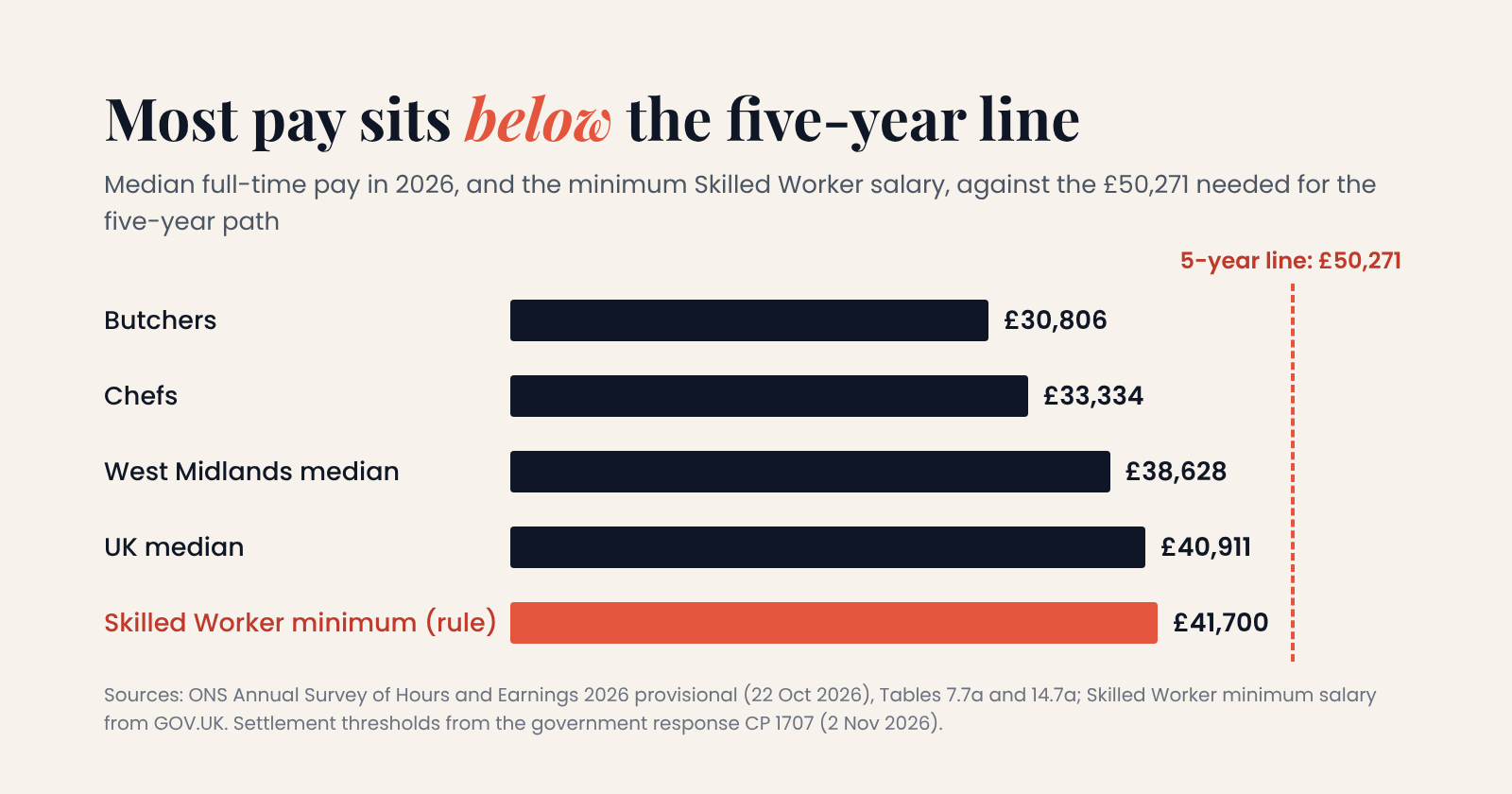
The Migration Advisory Committee says the minimum Skilled Worker salary of £41,700 sits at the 30th percentile of pay in eligible graduate-level jobs, and the median is £52,500. On those figures, somewhere between 43% and half of pay in those jobs falls below the five-year line. Workers already here in jobs below degree level, such as chefs (typically £33,334) and butchers (£30,806), are further from it still.
The government says it heard this. Its summary of the consultation records “concerns about regional pay differences and the impact on lower-paid but socially valuable occupations”. I am not convinced the final framework answers them.
Credit where it is due
The government did listen on some points. The 15-year path for jobs below degree level has been dropped. Care workers who arrived before May 2025 keep a five-year route if they earn £25,000 and stay in genuine sponsored work. Health and education workers on national pay scales who arrived before May 2025 are protected, and Skilled Workers sponsored before April 2024 can keep extending on their current terms until 2035. Those changes will help many people.
But they protect specific groups. The government says plainly that there is no wider exemption for people already living here. The software tester who arrived in 2025, doing everything asked of her, is now on a ten-year path.
What I would ask
- Publish the full impact assessment before the new Immigration Rules are laid, so Parliament can see who is affected and where.
- Look again at a single national threshold. A five-year path that most workers outside London cannot reach is a regional policy in practice, whether or not it is meant to be.
- Count sustained contribution alongside salary. Someone who has worked and paid tax for five years at a typical wage has earned something too.
For employers
If you sponsor staff earning under £50,271, many of them will now be looking at ten years instead of five. Some will be anxious, and some will start looking elsewhere. A short, accurate note to staff now is better than rumours, and so is a plan for who needs support and when.
Employer with sponsored staff under £50,271?We can review your sponsored workforce and help you plan what to tell staff, and when.
Where do you stand?
Should someone on £45,000, working and paying tax, wait twice as long to settle as a colleague on £51,000? I would like to hear from employers, workers and other advisers, especially if you see it differently. Add your view in the form below.
What do you think?
Whether you agree or not, we would like to hear from workers, employers and other advisers. We read every view and publish a selection here, with your permission.
Please don’t include details of your own immigration case, such as your visa dates, history or anything about a conviction. We can’t advise in public. If you need help with your situation, book a consultation.
Sources
- A Fairer Pathway to Settlement: Government response to the consultation (CP 1707), GOV.UK, 2 November 2026: dependants aged 18 to 24 and 25 or over; public funds; immigration breaches; Annex A (people affected) and Annex B (fiscal estimates).
- Migration Advisory Committee, Review of salary requirements, January 2026.
- ONS, Employee earnings in the UK: 2026 (ASHE provisional), 22 October 2026, Tables 7.7a and 14.7a.
- Home Office immigration and nationality fees, 8 October 2026 and GOV.UK, Immigration Health Surcharge. Cost figures are illustrative, at today’s fees, for one 5-year Skilled Worker visa plus one extension, excluding employer costs and future fee changes.
- GOV.UK: Skilled Worker visa (no access to most benefits), Student finance: who qualifies, Citizenship if you have indefinite leave to remain.
You’ve reached the end. Want us to look at your own situation against the current rules?
Book a consultationThis article is Vishal Gautam’s personal view and general information, correct as at 3 November 2026. It is not advice on your situation.
Related insights
Will the 10-year ILR rule apply to current visa holders? The 2026 earned settlement shake-up
Last reviewed 11 Oct 2026 · 6 min readSettlementEarned settlement confirmed: what the new ILR rules mean for you
Last reviewed 2 Nov 2026 · 10 min readWork visasGraduate visa to Skilled Worker in 2026: what the switch now requires
Last reviewed 11 Oct 2026 · 6 min readQuestions answered, sorted.
Book a consultation in Birmingham, in London or Manchester by appointment, or by phone or video call.